
March 2023 – Movement Methods & Techniques

This newsletter focuses on movement methods and techniques. What are they? What influences them? How to develop them?

Hi everyone,

Welcome to those that are new to this newsletter, the aim is to write one each month which hopefully gives people the have chance to read before the next one comes along!

Wow, we are almost a quarter of the way through the year, and I know I am struggling to keep up with my new year resolution of “getting stuff finished”…

If you are reading this online, and would like the next one to land in your email, then please click this link. Alternatively, if you have received this via email and wish to unsubscribe the details are at the bottom!

Finally, as always thanks for your support…

Let’s go!

Methods and Techniques?

In applied systems thinking, the terms ‘method’ and ‘technique’ are defined as:

  • method – a particular procedure for accomplishing or approaching a task
  • technique – a way of carrying out a particular method

In human movement, these two are often combined and referred to as ‘technique’.

For example…

  • method – common movement pattern
    (e.g. spin bowling technique, fast bowling technique, power hitting technique, etc)
  • technique – individual movement pattern
    (e.g. specific technique individual adopts to complete the tasks above)

Although using technique for both is not wrong, this creates confusion.

For example, in fast bowling, research on the optimal technique (method) has highlighted the fastest bowlers have the fastest run-up speeds…

Yet, the optimal individual technique is not to run in as fast as possible or as fast as someone else.

One of my favourite quotes on this issue is by Butch Harmon, the golf coach, who says ‘that if you want to play golf (method) like Tiger Woods (technique) you better be Tiger Woods.’

To ensure that safe and suitable coaching applications are employed it is important to understand how the science, theory and opinions apply and differ for methods and techniques.

What influences method frameworks?

From my experience, there are generally three approaches coaches build their own method frameworks (understanding) for a movement pattern:

  1. Their own experiences“that’s the way I learnt/did it”
    One of the most common influences on the way we teach is how we were taught or learnt knowledge.
  2. What a similar sport or the best do“imitating the best”
    There’s loads of phrases around imitation but regarding learning Aristotle wrote ‘human beings are the most imitative creatures in the world, and learn at first by imitation’.
  3. Human movement principles“that’s what the science says”
    Knowledge. Theoretically understanding what is the best way for our bodies to move to complete the task. (See February 2023’s newsletter on kinetic chains for instance)

In practice, I use a combination of all three to assess my practice, reflect, and evolve my framework as my knowledge around the movement pattern evolves.

Once developed this can also be used to question technique – why is it different?

What influences individual techniques?

Brace yourselves…. here comes another engineering concept with a funky name!

(Sorry I have a maths degree and love systems theory)

My theoretical framework for human movement is structured on dynamical systems theory.

Dynamical system theory is a branch of mathematics which allows the behaviour of complex systems to be described using constraints.

There’s a great paper on this theory being applied to human movement systems by Davids et al., 2003 (see Movement systems as Dynamical Systems ).

They adapt Newell’s model (1986) which suggested that the behaviour of a dynamical system is shaped by three types of constraint:

  1. Organismic – those relevant to the individual
    (e.g. size, strength, range of motion etc.)
  2. Environment – those relating to the environment the system within
    (e.g. indoor, outdoor, equipment, etc.)
  3. Task – the constraints based on the movement task
    (e.g. outcome of task, rules of the sport etc.)

This model was adapted to include movement coordination based on previous experience of the movement by Davids et al., (2003).

This relates to the intrinsic movement patterns that individuals learn and develop as they gain information from producing the movement.

When attempting to produce a movement pattern, our brains consider all these factors, and produce a technique (performance) which aims to deliver the desired outcome.
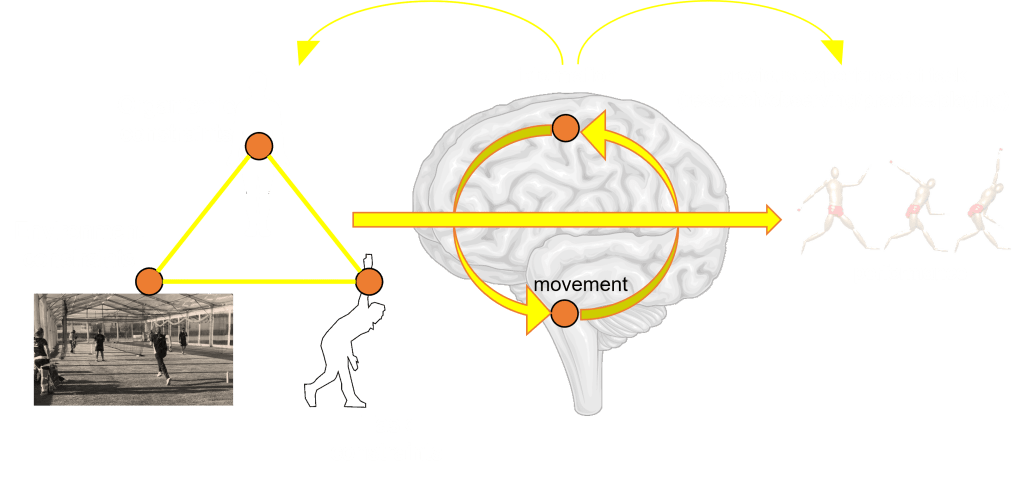
Newell’s model (1986) of interacting constraints incorporating movement coordination for fast bowling (adapted from Davids et al., 2003)

In sport, the success of the technique to complete the task, it is often analysed and judged.

It is important to build and develop the understanding of how these constraints and movement patterns impact our method frameworks.

For example, there is emerging research which suggests the movement patterns females adopt in bowling and batting may differ from their male counterparts.

My framework has therefore evolved based on this understanding of how the organismic constraint differences impact technique.

How?

Well as Leonardo Da Vinci, once said ‘To develop a complete mind: Study the science of art; Study the art of science. Learn how to see. Realise that everything connects to everything else.”

For me this takes the following approach…

Study the science of art; Study the art of science... interact with the science, the theory and opinions. There is value in all of it.

Learn how to see… acknowledge the information in the light it is displayed (knowledge vs opinion). We do not know all the answers, people theorise, and science investigates. Appreciate social media is a great place for theories… but many are not yet proven.

Everything connects to everything else develop links between methods and techniques. Question what you see and why they do it differently. Compare with your experiences, what others do, and what the science says.

That’s all for this month

To recap:

To ensure that safe and suitable coaching applications are employed it is important to understand how the science, theory and opinions apply and differ for methods (the common movement pattern) and techniques (individual movement patterns).

In practice, I use a combination of my own experiences, how others do it, and scientific principles to develop my method frameworks.

I use a dynamical systems theory approach to question how techniques are influenced by organismic, environmental and task constraints, as well as previously developed movement coordination patterns.

Thanks for reading.

Paul

February 2023 – The Kinetic Chain Principle

This newsletter focuses on the kinetic chain principle and it’s application in human movement. What is it, how does it work, and why is it useful?

Hi everyone,

Firstly, welcome to those who have recently subscribed, and hello to those that are long term followers of this newsletter.

If you’d like to subscribe so this lands monthly in your email, then please click this link. Alternatively, if you wish to unsubscribe the details are at the bottom of the email!

Let’s go!

What is the kinetic chain principle?

The kinetic chain principle is an engineering concept.

It is used to explain how a series of connected segments generate and transfer momentum between each other when moving.

This sounds complicated!?

Bear with me…

So how does this relate to human movement?

Well… the body can be considered as a series of connected segments.

Each limb is a segment connected by tendons and muscles. These play specific roles in generating and transmitting momentum to perform movements.

This concept can therefore help us understand theoretically how the body should move to produce consistent and fast movements.

This can help us improve performance, as well as, help reduce the risk of injuries.

It should be noted, however, that this comes with a caveat.

The kinetic chain principle provides a generalised technique which conforms to physics and fails to consider the unique individuality of the human body.

It is important to remember, that this technical movement pattern will vary based on individuality.

So while it provides us with an idea of what good theoretically looks like, we must remain wary that it may not be optimal or achievable for every individual.

How does it work?

The whole concept is based on Newton’s Laws.

Newton’s first law highlights that some objects are harder to change the motion of than others. This concept is also referred to as ‘inertia’.

Newton’s second law states that how quickly an objects momentum changes depends on the net force acting on the object.

Now this can be a bit tricky to visualise or describe with text…

But if the same force is applied to two different objects with different inertias, this law states the change in momentum of each object will be the same (often known as the conservation of momentum).

Since momentum is defined as the product of inertia and velocity… the only way the change in momentum can stay the same when the inertia of the object changes, is for the the velocity to change to conserve this relationship between force and momentum.

A few years ago, a coach asked if a Newton’s cradle was a good example of this… which it is (mostly) and ever since I have been using this video (from 2.05 onwards) to help explain this law…

As the inertia of the bead changes, the velocity of the beads change to maintain the momentum!

Newton’s third law states that for every action force, there is an equal and opposite reaction force.

In a kinetic chain, these combine and can help us understand the theoretical optimal movement pattern for maximal efficiency and end-point velocity (e.g. kicking, throwing, striking).

In the body, the proximal (closest to the centre of the body) segments have greater inertia than the distal segments (furthest away from the centre of the body).

This makes them good for stability and for developing initial momentum within movement patterns…but not so good for moving quickly.

The distal segments with their smaller inertias are better designed to move quickly.

Rather than moving these distal segments individually, the kinetic chain principle indicates that the segments all contribute…

The momentum generated in each segment can be transferred in a proximal to distal sequence with the transfer occurring when the proximal segment best aligns with the task outcome (e.g. running location, throwing target, or hitting direction).

If you go back to the video above, we can think of these beads as representing different segments of the body – the momentum is initially developed in the big proximal segment and then transferred to the smaller distal segments to maximise velocity…

The importance of alignment can be seen when the distal bead initiates the reverse distal to proximal sequence and the lack of momentum that transfers back through to the distal bead.

This is a good example of how we can reduce or dissipate momentum, but care needs to be taken in humans that the body is designed to dissipate the momentum in that direction.

In general, the kinetic chain principle is often summarised into the following key principles for human movement:

  • Stability – proximal body segments should provide a solid base of support to allow for a effective and efficient transfer of momentum to the distal segments
  • Proximal-distal sequencing – initial momentum should be generated in the proximal segments, before generating and transferring momentum to the distal segments
  • Alignment – the transfer of momentum from the proximal to distal segment should occur when the proximal segments momentum best aligns with the task outcome

Why is it useful?

In sporting movement patterns, the sequencing and timing of the generation and transfer of momentum between segments is key in optimising performance and minimising injury risk.

The kinetic chain principle provides a framework for movement patterns to be broken down and assessed theoretically.

Most movements conform to a sequence of phases based on the key principles of human movement. For example…

  • Initial phase – initial momentum is generated in the proximal segments
  • Preparation phase – initial momentum of the proximal segments is stabilised to provide a base of support, while the rest of the body is organised ready to maximise the proximal to distal sequencing
  • Transfer phase – momentum generated and transferred into a proximal to distal sequencing when the segments best align with the outcome

What about the follow through?

This phase is often not considered when thinking about performance, but it crucial that stability of the proximal segments is maintained since this provides the base for the next movement task.

To dissipate momentum, the same principles can be applied in reverse.

The momentum in the distal segments can be transferred in a distal to proximal sequence (see video above).

Care needs to be taken, however, that the body is designed and capable of dissipating momentum in that direction.

That’s all for this month

To recap:

The kinetic chain principle is an engineering principle which allows us to think about the body as a series of connected segments.

This leads to the following key principles for human movements:

  • Stability – proximal body segments should provide a solid base of support to allow for a effective and efficient transfer of momentum to the distal segments
  • Proximal-distal sequencing – initial momentum should be generated in the proximal segments, before generating and transferring momentum to the distal segments
  • Alignment – the transfer of momentum from the proximal to distal segment should occur when the proximal segments momentum best aligns with the task outcome

These can be used to help provide an initial theoretical framework to analyse sporting movement patterns.

It is important to remember, however, that movement patterns vary based on individuality, so while it provides us with an idea of what good theoretically looks like, we must remain wary of what is achievable for a particular individual.

Thanks for reading.

Paul

January 2023 – Thinking about human movement

Hi everyone,

Welcome to my third newsletter & the first hosted via my new website.

Firstly, thank you to all of you that have read the newsletter so far and for those that replied with some very kind feedback or some encouragement to get this one out – I have squeezed it out in January just!

Let’s go!

What is systems thinking?

Systems thinking is an approach to problem-solving and decision-making that considers the interconnected and interrelated elements of a system as a whole.

For example, applying this to human movement.

Systems thinking can be used to analyse the movement pattern of a task as a system made up of the various interacting components of the body.

Considering the entire movement as a system and analysing the interrelated elements, leads to several positives:

  • a more comprehensive understanding of technique by considering the entire system and the interactions between its elements
  • more effective and sustainable solutions which address the root cause of the problem
  • encourages collaboration between practitioners and experts to solve problems due to the interconnectedness of the elements within a system
  • promotes innovative thinking and solutions to complex problems which have previously not been resolved
  • improves longer term outcomes and more sustainable solutions due to their improved alignment with the entire system

In general, systems thinking provides a wide and comprehensive approach to problem-solving and decision-making, which can lead to improved outcomes and more sustainable solutions.

What is reductionist thinking?

Reductionist thinking considers problems by breaking them down into smaller, simpler parts, and examining each part in isolation.

For example, applying this to human movement.

Reductionist thinking can be used to break down the movement patter of a task into smaller, simpler parts prior to analysing them.

Reducing the entire movement into smaller, simpler parts and analysing them has several negatives associated including:

  • a limited perspective on how the problem affects the bigger picture
  • incomplete or ineffective solutions which fail to identify and address the root cause of the problem
  • over simplification of the movement system which promotes a limited understanding of the problem and available solutions
  • a narrow focus (cognitive tunnelling) that the solution to the problem lies within this individual component
  • missed opportunity to improve by linking potential individual component problems to a wider issue

In general, reductionist thinking can provide valuable information about individual components, but is limited in addressing complex problems and achieving sustainable solutions.

Why is this a problem in human movement science?

In human movement, reducing movement patterns into smaller, simpler parts helps with gaining valuable information and identifying potential problems.

It is however, very limited and arguably dangerous to adopt this approach to base technique interventions.

Why?

It fails to consider what effect a change within this individual component has on the wider movement pattern.

That is before we consider the potential effect on performance.

It should not be surprising that this very often therefore leads to incomplete or ineffective movement patterns most of which have elements which are associated with increased injury risk.

Nevertheless…

This approach in coaching is quite common.

Social media is awash with reductionist approach coaching advice.

For example, posts advocating that pace bowlers just need to run-up faster and/or keep a straighter front leg to bowl faster…

This fails to consider the bigger picture and the effect on the whole movement pattern and task.

What happens if I sprint in?

The movement pattern in other parts will change and almost certainly for the worse.

Why does this still gain traction?

Because for some people it will work.

And this creates an issue, because social proof is the best kind of advertisment.

It is similar to personal trainers posting images of their client’s bodies before and after their intervention… how many do you see where the intervention has failed?

But what’s more, you only see those that have the intervention has been successful for.

Those it failed, often walk away from the sport with a catalogue of injuries behind them.

My approach…

I utilise systems thinking in much of the research and consultancy that I undertake.

This does not mean I do not reduce movement patterns into smaller, simper parts.

I do.

For example, I often break bowling actions down into phases consisting of:

  • the run-up (pre bound)
  • the preparation phase (bound to front foot contact)
  • the delivery phase (front foot contact through ball release to the follow through)

The key however, is that these phases are linked and so are the components within them.

For example, the movement position at the end of the run-up is the movement position which begins the preparation phase.

If there is a problem in the run-up phase it is likely going to impact the preparation phase, and most likely the delivery phase as well.

It is therefore very difficult to technically remediate something in the delivery phase using a reductionist approach (e.g. a front knee angle) if what happens in the preparation phases is the cause.

To identify the problem, I may use a reductionist approach to analyse individual components and generate knowledge, but to solve the problem and make a decision on potential technique intervention I will return to a systems thinking approach.

This has lead to more effective and sustainable solutions.

It also allows for the consideration and questioning of the interconnections and interdependencies within the system.

This also provides a good basis to develop knowledge and understanding, as well as reviewing interventions and understanding unexpected outcomes.

That’s all for this month

To recap this edition:

  • Systems thinking is an approach to problem-solving and decision-making that considers the interconnected and interrelated elements of a system as a whole, rather than reductionist thinking which focuses on the individual components in isolation.
  • Reducing human movement patterns using a reductionist approach can lead to ineffective and unsustainable solutions which often result in negative changes in performance and injury risk.
  • Using systems thinking to analyse human movement can lead to more effective and sustainable solutions by allowing the consideration and questioning of the interconnections and interdependencies within the system. This provides a good basis to develop knowledge and understanding of the whole system, as well as reviewing interventions and understanding unexpected outcomes.

Thanks for reading this.

Paul

December 2022 – Cognitive Tunnelling & Coaching

Hi everyone,

Welcome to my second newsletter.

First of all, a massive thank you to all of you that read the first edition and for those that replied with some very kind feedback.

Let’s go!

My experience…

It happened towards the end of my PhD in 2015.

I had spent a lot of time and effort investigating the optimal technique in fast bowling, as well as, applying and developing this knowledge in practice.

At some point I started to only focus and consider the information I had developed or learnt from my bubble of support.

I developed this ridiculous mindset that…

Anything else did not matter and was no help to me.

So what changed?

I defended my practice/opinion on social media with what I was doing.

(I still cringe now!)

I took a step back and realised I had been so focused on my point of view and proving it…

That I was ignoring and dismissing any secondary information that may also be important.

I was experiencing cognitive tunnelling.

What is cognitive tunnelling?

It is a phenomenon.

A mental state.

Where your brain hangs on to the the thing which is most important or closest to you…

To the point where that it cannot see the rest of the environment or other relevant information and data.

In Parham Doustdar’s blog he explains it using a story about a start-up business looking to sell cars online.

So they set up a website…

The initial web traffic was huge, but nobody bought anything.

Focused on the sale numbers, they temporarily closed the webpage to redesign it thinking they had made a mistake when building it…

In the meantime, those who had looked and decided to come back later to buy couldn’t.

Their focus on a lack of sales and the assumption that this was related to the design of the website led to them ignoring other potential explanations.

As a result the start-up failed.

Perhaps the most tragic example of this phenomenon is the story of TransAsia Airways Flight 235 which crashed shortly after take-off in Taipei.

Where after a single engine failure…

(an emergency situation but one which should have been manageable)

the pilots mistakenly shutdown the good engine.

Working under the assumption they had shut down the good engine…

Cognitive tunnelling took over as the pilots focused on trying to solve an additional problem and ignored the engines as a potential cause..

When they realised what had happened it was too late.

Only 15 of the 58 on board survived.

It is also not a phenomenon to disregard and think that cannot possible happen to me.

Ever been told you are ignoring someone but never heard them speak while preoccupied with another task?

Walked into someone or something while glued to your smartphone while walking?

These are also examples of cognitive tunnelling.

How is this relevant to coaching?

As coaches, we are as susceptible to this phenomenon, and perhaps more so than people in other industries.

Our practice is based on giving and receiving feedback.

Anything that could influence or impact this cycle which results in a misinterpretation or a key detail being missed is a danger.

There are four scenarios where I have seen it manifest and create issues within practice.

Knowledge tunnelling

A pace bowler trains in a pathway where mixed actions are remediated as they are associated with lower back stress fractures.

After a period of remediation to a side-on action, the bowler suffers a stress fracture

The bowler does their physical rehab, and completes more technique remediation.

The bowler returns to bowling and suffers another stress fracture.

This process continues and the player eventually retires.

What is the cause of the cognitive tunnelling?

The focus on the knowledge that lower back stress fractures are associated with mixed bowling actions classifications.

(based on research from a few decades ago)

This focus, and belief that this is the correct thing to do, prevents them from considering whether this remediation caused the stress fracture.

(Doing so may have highlighted recent work by Pete Alway at Loughborough University – this will be the focus of a newsletter in the new year)

SPOILER – MIXED ACTIONS ALONE DO NOT CAUSE STRESS FRACTURES!

Problem tunnelling

A junior batter develops a problem against the short ball and regularly gets hit after getting a new bat.

After some sessions working on the players technique there is minimal improvement.

The batter starts to turn up to less sessions and becomes disengaged.

What is the cause of the cognitive tunnelling?

The focus that the problem was technique-based and not caused by the new equipment altering his movement patterns (e.g. too heavy/big etc.).

(another example might be focusing on technique to remediate an illegal action and not considering any physical constraints of the shoulder)

This focus on the assumption that the problem is technique-based can quite quickly lead to cognitive tunnelling.

Often to the point where factors such as whether the desired movement pattern can actually be achieved by that individual are forgotten.

Solution tunnelling

A player had an issue with getting out LBW due to their trigger movement.

Their technique was remediated successfully and this reduced the number of LBW dismissals.

A second player has the same issue, but the same remediation does not work.

What is the cause of the cognitive tunnelling?

This is similar to the knowledge example.

The assumption that this solution will work for this individual because it has previously worked.

This reaction leads to a remediation beginning without considering the player as a different individual and an evaluation of the whole picture.

It often ends in frustration and confusion that it is not working.

Outcome tunnelling

This one is a bit different but also important to be aware of.

I have experienced this as a practitioner and as a mentor.

Both times, the problem in question was potentially life-changing and career-threatening…

(pressure and/or stress have been linked with cognitive tunnelling)

So what happened?

After a period of time, the remediations in both cases were pretty good but they were not perfect.

An illegal action was remediated to a legal level of extension but not zero extension.

A bowler with a history of multiple stress fractures remediated their action to reduce risk substantially but it did not remove all risk.

The focus on attaining perfect solutions during remediation is good but using this as the goal posts for a return to play led to cognitive tunnelling…

The original aim of the remediation was lost.

The goal was not to make them perfect…

But to get them in a position to return to play with a technique which either improved legality or reduced injury risk.

How do I prevent cognitive tunnelling?

Since it is a mental state – it is almost impossible to stop.

It cannot be turned off.

But it can be counteracted.

Being aware that cognitive tunnelling occurs is probably the first step.

Knowing this – I try to keep an open mindset to what I could be missing from the wider environment.

Some methods I implement in my practice which help…

Frameworks

I use a human movement framework to work through problems.

It helps me understand and explain what is going on.

Why it is happening.

And what I expect to happen if I change something.

I then evaluate whether this happens to see whether my expectations match reality.

If not I reassess to see what I have missed.

Practice Partner

I have a number of people I trust.

I will ask them for an opinion or feedback if I am unsure.

I often work with coaches and ask them what do they think first to get their independent opinion.

I consider this, how it fits in to what I think, and whether it is something I have missed.

I also ask for opinions when something is not working.

As well as reviewing successful remediations with them after the event to learn what they may have thought or done differently.

Shorten the journey

Often the smaller hurdles or targets get lost in the bigger picture.

Most movements in sport can be broken into a series of smaller movements.

I often break down this bigger picture into smaller pieces which can be remediated in order to help solve the bigger issue.

Appreciate the odds

Coaching is trial and error.

I expect most of the remediations I try to need refining and the odds of finding the golden bullet quickly are quite high.

Starting with this appreciation that humans are complex and there is no guaranteed best approach for any remediation…

Opens the mind to the whole environment from the start.

That’s all for this month

To recap:

Cognitive tunnelling is a mental phenomenon which occurs when we focus on a single point or point of view to an extent where we cannot see the rest of the environment or other relevant information and data.

This has the potential to occur in coaching potentially in the following scenarios:

  • knowledge tunnelling – fixation on a piece of knowledge prevents remediation of the problem
  • problem tunnelling – fixation on your opinion of the problem prevents remediation of the problem
  • solution tunnelling – fixation a previous successful solution prevents remediation of the problem
  • outcome tunnelling – fixation on trying to perfect the outcome prevents recognition remediation of the problem has occurred

Some strategies I adopt to minimise the effect of cognitive tunnelling on my practice are:

  • developing frameworks
  • utilising practice partners
  • breaking up the remediation journey
  • appreciating the odds

Thank you for reading this.

I wish you a Happy Christmas if you are celebrating, and all the best for the New Year.

Paul

November 2022 – World Class Practice & My Journey

Hi everyone,

Welcome to my first newsletter.

First of all, a massive thank you to all 144 of you that have joined me on this journey. If you have not subscribed, click this link or please share this with others to grow the community.

This month’s newsletter reflects on how Google got me into this, world-class practice and where I am in this journey.

Let’s go!

How did I get into Biomechanics?

I was close to never making this journey.

Why?

Well as a Math’s graduate I was supposed to go and get one of those nice graduate scheme jobs in London.

So what changed?

Well you can blame Google.

It was January 2009.

Dreading joining the rat race and unemployment looming large post graduation…

I opened Google and entered ‘Maths and Sport’

At the top.

Sports Biomechanics Masters – Loughborough.

Perfect.

Thirteen years later…

(thanks to Google’s algorithm and some great people – more on that shortly)

Here I am.

World-class approach

I recently discovered Corey Wilks among others.

Hungry to learn more.

(and not to waste my recent paternity)

I started subscribing to newsletters of content creators, copywriters, scientists, coaches etc.

I wish I had done it sooner.

(for those interested… I started following a few.. kept those which work for me… and leveraged them to develop a variety of skills)

Why do I love this?

Someone else is doing the hard-work (collating the knowledge) and translating the key messages – saving me LOTS OF TIME.

Oh, and it is FREE!

Anyway, back to the world-class approach…

In one of Corey’s newsletters he discusses the 3 Pillars of World Class Coaching.

He talks about the effort it takes to develop into world-class :

‘World-class coaches, like all elite-level performers, spend decades putting in a metric ton of effort to make the end result look effortless’

And the three fundamental skills which require mastering:

  1. Building Rapport
  2. Asking Open Questions
  3. Practice Active Listening

Where am I on my journey?

Thirteen years in.

I have more letters after my name than in it.

These were gained through dozens of classes and hundreds of hours of supervision from superb academics.

(special shout out to Dr. Mark King and Dr. Fred Yeadon for their role in shaping this, and Stuart McErlain-Naylor and Pete Alway for there ongoing support)

Add to this a list of funky job titles centred on Biomechanics and Human Movement Science.

And some may be adding expert to their CV and social media bios.

But…

Knowledge and practice continually evolve.

Those letters and job titles only confirm that I was once able to demonstrate that I had some key knowledge and skills.

What was once world-leading, can soon become world-misleading.

(Think mixed actions and stress fractures – more on this in a future newsletter)

It is why I continually look for opportunities to self-develop and I am delighted to be starting the ECB Advanced Coach Course in January.

My thoughts on those skills?

Building rapport

‘Rapport is just about making people feeling comfortable enough to open up and have a deep, meaningful, candid conversation.’

Corey Wilks

When I first started. I was terrible.

I spent what felt like a couple of years with no idea what half the technique language meant.

I just agreed and bluffed my way through it.

But I was lucky.

World-class people invested and built a rapport with me.

(none more so than Kevin Shine)

They spotted a talent in me (or I lucked in with my nods).

Over time I was able to understand their knowledge and build mine.

Eventually, I was able to start extending this knowledge and the tide turned.

They started wanting to understand my knowledge to build theirs.

I now have a large network with which I can have deep, meaningful and candid conversations.

How do I build this network?

I offer to invest time getting to know them.

Every student, player or coach I build a rapport with is an opportunity for me to learn from their knowledge and experiences as much as they have the opportunity to learn from mine.

This approach features heavily in my teaching and coaching philosophy and sits nicely with my curious nature.

Asking open questions

I used to have quite a closed mindset to technique.

I do not mind admitting this.

When did this change?

I spent a period of time consulting on a bowler with an illegal action.

There was a common census at the time that illegal actions were due to technique issues.

Based on this closed approach, we spent almost a year focusing on changing the bowlers technique.

Nothing changed!

One afternoon, I was messing around with a friend with a shoulder mobility issue. He could not bowl with a straight arm.

The light bulb moment.

The bowler could not do what I was telling them.

My mistake?

I never asked any open questions or consider anything else.

A few months later, after some work with the physio they returned to the game with a legal action.

And have been playing professionally ever since.

I got lucky.

They easily could have been lost from the game if circumstances had not been so kind.

Ever since, I question what an individual can do before recommending technique change.

This has led to coaches taking more appropriate action leading to incredible results.

Practicing active listening

Active listening is about listening so deeply you can synthesize and offer context to what someone says to help them make connections they wouldn’t have made on their own.

Corey Wilks

I am an over user of this quote by the Dalai Lama (apparently).

When you talk, you are only repeating what you already know. But if you listen, you may learn something new

Dalia Lama

I learn the value of practicing active listening very early.

I mentioned earlier that I spent what felt like a couple of years with no idea what half the technique language meant.

I was in at the deep end, I had to learn, and eventually I was going to have to help make connections.

It is not until recently however, that I have discovered the power of writing these down while listening.

It has allowed me to build upon these and develop conversations rather than thinking about these and returning to them at a later date.

Final thoughts?

These skills are not mutually exclusive.

There is no good building rapports if you do not employ open questions to explore them and adopt active listening to interpret the answers.

When used together effectively it can rapidly accelerate your development.

But you also need to be prepared to handle critical feedback.

For example, I recently mentioned some feedback on Twitter I chose to receive from someone I have a good relationship with.

To paraphrase, it was along the lines of:

“Don’t forget your humility, respect where you came from, and remember those who support you along the way”

I initially I thought this may be a little harsh but on reflection it was probably fair.

Am I world-class?

That’s for you to decide.

But you will not find me claiming to be an expert, a guru, or the only person allowed to talk about a particular part of human movement science and cricket.

That’s all for this month

To recap:

I am in biomechanics thanks to Google!

I aim to continuously develop my knowledge and have developed key skills in:

  1. Building Rapport
  2. Asking Open Questions
  3. Practicing Active Listening

Thanks for reading.

Paul